Showing posts with label Japanese food. Show all posts

Friday, February 28, 2014

Three simple secrets to enjoying shabu-shabu


To someone unfamiliar with the dish, the name "shabu shabu" might suggest some sort of concoction involving exotic spices; in reality, it's merely vegetables and sliced meat boiled in a light broth; according to Japanese people, "shabu shabu" is the sound the meat makes when splashing through the broth. Making shabu shabu at home is ridiculously simple- all you need for the broth is about a teaspoon of hon dashi (bonito) stock and a splash of mirin- but there are several restaurants throughout NYC that specialize in the dish. The best part of making it at home, however, is that you get to choose the ingredients; basically, anything goes! There are only three rules to enjoying shabu shabu, which I've shared below.

1)The meat must be thinly sliced. This ensures that it will cook quickly and evenly, so that it will retain its flavor and good texture.

Shabu-Tatsu's rib eye dinner course ($27/person, includes assorted vegetables, noodles, salad, dipping sauces, rice, and ice cream.) 216 E 10th, Street New York, NY10003 
2) There must be some form of "shime" . Don't panic- all that means is rice or noodles to dip in the broth after the veggies and meat are finished, to soak up the flavor. Refrain if you must, carbaphobes, but be warned: you'll be missing out on the valuable nutrients that the chosen shime soaks up from the leftover broth.
Kishimen & Maloney Noodles


3)Loved ones to share it with. Like many Japanese meals, shabu shabu is meant to be eaten with friends and family whose company you enjoy. The diy aspect makes it not just another dinner, but a communal experience!   


Monday, February 3, 2014

Natto Sando


As I mentioned earlier in this blog, there are many ways to enjoy natto. If you haven't found a way to do so yet, natto sandos, which consist of natto sandwiched between age tofu and doused in soy sauce (bonito flakes optional), are definitely worth a try. Think about it: when was the last time you ate something fried and salty that you didn't love? Best of all, they're super easy to make. Here's how it's done:
-Preheat oven to 375 degrees Fahrenheit. If you don't have an oven a toaster oven will do the trick just fine.
-Slice two pieces of age tofu down the middle to make four "pockets". You can find age tofu in any Asian market or better grocer.
Age (fried) tofu

-Open two packages of natto and mix contents (if unsure you can totally refer to http://seamny.blogspot.com/2013/09/nattoslimy-yet-satisfying.html). Scoop half of one package into each age tofu pocket.
-Put the "sandos" on a pan and insert into the oven/toaster oven. Let bake for 5-10 minutes.
-Add soy sauce and bonito flakes as desired. Toothpicks optional!
Natto sandos with soy sauce and bonito

Monday, January 27, 2014

Spicy Kimchee Nabe

Full disclosure: I love to cry when I eat. Not tears of sadness, but the kind of tears that result from consuming something so spicy that, in addition to firing up the intestines and causing beads of sweat to manifest on the skin, it overcomes the sinuses to force droplets of delicious joy to escape the eyes. Such a reaction is my definition of a complete dining experience. Which is why my obsession with Japanese food is somewhat curious, since most Japanese dishes are lacking in spiciness. Except those that are Korean inspired, such as Spicy Kimchee Nabe.
For a white girl with plenty of experience eating Asian food but not much experience making it myself, attempting nabe with such deep flavor was quite intimidating. The good news for me is that this dish is entirely dairy-free; no heavy creams that make my skin crawl simply because they are suspected of being the main ingredient in cellulite. Also, the directions are fairly simple: boil up some water, throw in some veggies, and add some seasoning. Here's what I used to make my very first Spicy Kimchee Nabe:
-about 4 cups water
-1 cup bean sprouts
-1 cup nappa, chopped
-4 shitake mushroom caps, quartered
-1/4 package tofu
-3 pieces kimchee, chopped
-4 tbsp "Togarashi" red pepper  (as pictured below)
Pay no attention to the 12/31/13 expiration date; if you keep your pepper in the freezer it will last. We used it last night and we're still alive and kicking.

-1 tbsp mirin
-1 tbsp miso

Boil the water in a pot, ideally a clay "nabe" pot. Add the nappa first, since it's the most firm of the veggies and will take the longest to cook. The beansprouts and the shitake can follow shortly after. Hold off on the tofu until the veggies start to soften, since tofu gets weird holes in it when it's boiled too much. Once that happens, add the pepper, then wait 30 seconds and add the kimchee. Right before everything is ready, add the miso and mirin. Stir for 2-3 minutes and then serve. It's as simple as that! Oh, and be sure to keep whatever soup is leftover, as it will make an excellent base for shin ramen the next day. 

Wednesday, January 1, 2014

Christmas @ Kyo Ya (aka a Festivus Feast)


Flash forward to Christmas Day. We'd been back in New York for exactly three weeks, and we had a serious hankering for some good washoku that we didn't have to cook by ourselves. To celebrate the holiday and satisfy our craving, we headed to what is probably the most elegantly authentic Japanese restaurant in all of New York City (I'll leave it to you to look up where it is...I don't give up my secrets that easily!)
We start off with some seafood...

Nanbanzuke (Small fish similar to sardines that are marinated in vinegar)
served with onions 


These succulent oysters garnished with ginger and peppers were as
amazing as they look!
Uni (sea urchin) sashimi. With its impossibly creamy texture, it's no wonder
this delicacy has been referred to as the sexiest food in the world! 
Ebi fry (shrimp) with gobo (burdock)- super crispy!


Move on to some white meat...


Jidori (Organic chicken). See how it's pink in the middle? It does indeed mean that
it hasn't been fully cooked. But since jidori is both free range and organic, the risk
of samonella that scares people into charring their chicken is extremely low.  


Kurobuta (black pork). It comes from the underside, or belly, of the pig, and when
cooked correctly as shown here it literally melts in your mouth.


...And finally, some shime (which is what Japanese people call a rice or noodle dish served at the end of a meal)!

Unagi over rice

Inaniwa Udon, which consists of noodles flatter and a bit finer than your average udon. 
Their display of omotenashi, complete with a gift of chocolate cake that they let us take to go,  made us feel right at home! It was the kind of incredibly attentive service we'd become accustomed to in Japan, right here in NYC.

Sunday, December 29, 2013

Day 11: Monja Mangia!

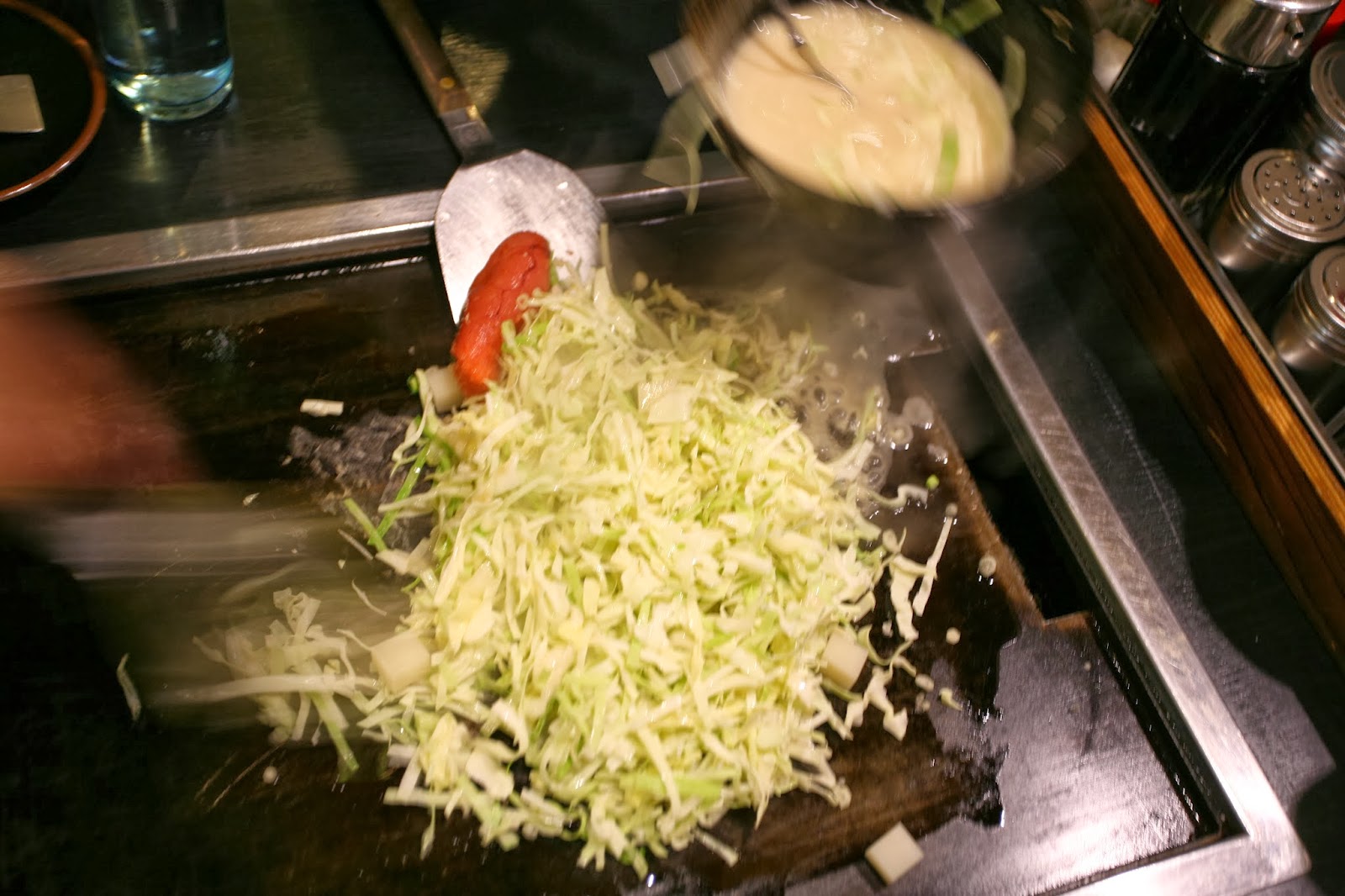
Japanese people may describe monja as their take on pizza, but as a born and bred Brooklyn girl who takes her slice seriously, I don't buy it. For one thing, there is no cheese involved; rather than shredded mozzarella, chopped cabbage is scattered on top of a batter that resembles pancake. If you're gonna compare it to anything, compare it to IHop! Except that the fact it contains so much cabbage would make it healthy by American standards.


Tuesday, December 17, 2013

Day 7: Fukuoka Tonkotsu Ramen

Since the day his friend brough back a package of  not-so-instant Tonkotsu Ramen from his hometown of Kyushu, my fiancee's been raving about it; while the boxed version was amazing, the real thing was even better. Perfectly al dente noodles, thinly sliced pork, and soup deeply flavored with the oils from the meat filled my bowl at this tiny ramen spot that seemed to be frequented by mostly blue collar workers. Bonus: extra noodles were free of charge!


Day 6: Kyoto Kazuki

Despite having been fed heartily the night before, we were a bit "onaka suita" (hungry) when we arrive in Kyoto the next afternoon. Following our amazing sandwich-to-go experience in Tokyo, I had a feeling that it would be equally as safe to purchase a lunchbox at one of the shops in Kyoto's station. I was right. 


For around $6 USD, this obento contained  tamago (egg), ebi (shrimp), kani (crab), and salmon mixed with egg noodles, lotus, and edamame garnished with ginger over a bed of rice. If I hadn't know better, I would have said there was no way this could have been prepackaged. Good luck finding anything this amazing in New York for under ten bucks!

Sunday, December 15, 2013

Day 5: Maisen and home cooked "Omotenashi"

After bidding farewell to our Chigasaki friends we headed to Tokyo to catch the train towards Shiga. On the way we grabbed a Maisen sandwich and Asahi from Tokyo Station (yes, you CAN drink beer pretty much anywhere in Japan...including the train station!) 

This Maisen brand "katsu sando" (fried pork sandwich) is nothing like anything you'd pick up from Grand Central or Penn Station. Although it's prepackaged, the bread is more moist than that used in any NYC deli sandwich, plus the pork cutlet is so juicy it pops in your mouth!
Later that evening, after a few stops around Shiga, we arrive at our friend's house and greeted with home-cooked "Omotenashi". Omotenashi is a word used to describe any meal prepared for a special visitor. While my boyfriend warned me that hosts preparing such feasts usually go above and beyond, I was not prepared for anything this extravagantly amazing; despite my stomach's begging me for mercy, my tongue kept yearning for more!
Omotenashi of baked potato, ika (squid), greens in sesame sauce, gobo (burdock) wrapped in pork, hamburg, tamago (egg) with brocolli and red peppers


Thursday, December 12, 2013

Day 4: Fisherman's Ramen at Okiemonmaru


Rumor has it that in any given seaside city, the best places to eat are where the fisherman have lunch. After visiting Okiemonmaru in Chigasaki, I can wholeheartedly vouch for that. The lack of odor despite the buckets of freshly caught fish outside the door suggested that the new arrivals would be gone before sundown.

The seafarers who just returned, however, were not responsible for the quick turnover. They sat at the long wooden tables slurping up ramen with such gusto that I knew I was in for something special. I was right. The shoyu ramen, which is ramen in a soy sauce based broth, was incredible. The pork was tender and juicy, the noodles were just right, and it was brought to the table piping hot (shamefully, many ramen restaurants in New York serve theirs lukewarm).  The most amazing part is that the broth had depth without being salty; this was the first time I'd eaten ramen that didn't make me want to down a gallon of water an hour later.


I've never been too keen on shoyu ramen, but thanks to Okiemonmaru it's on the top of my "must eat" list next time I visit Chigasaki. Who knew that you could find some of the best shoyu ramen south of Tokyo at a fish restaurant? Only in Japan! :-)

Wednesday, December 11, 2013

Day 3: Chigasaki Seafood Festival

We left for Chigasaki early Saturday morning for some much needed weekend r&r. Located about an hour an a half from Tokyo by train, Chigasaki is a bay city with boasts mountain views, good surfing, and some of the best seafood in all of Japan. Accordingly, our welcome lunch at a popular local spot consisted of sea dwelling creatures of a special variety I had never seen before.
Kinmedai


.
Sure, I've eaten snapper, but I've never eaten kinmedai (golden eyed snapper). The bare bones that remained once we were through with him evidenced our sheer enjoyment. But before that, there were starters. 
.


Nama shirashu are tiny, translucent black-eyed fish that taste kind of like sardines and are eaten raw; their saltiness makes them a perfect match for beer! Our generous server gave us a plate of shoyu shirasu (the same thing but dipped in soy sauce) on the house.
Nama Shirasu


Ika (squid) is one of my favorite types of sashimi, but I'd never tasted it quite like I did here.Not only did it taste as though it had been caught minutes ago, it had a tender, almost creamy texture. 

Toretate Ika (Ika Sashimi)
.The whitefish sashimi was equally as fresh, and the presentation just as gorgeous. 

We finished off with the sawara, a seasonal fish that we Americans know as spanish mackerel. The sprig of brightly colored ginger complimented it nicely.
Sawara
Afterwards, we took a "sampo" (walk) along the shore, Mount Fuji looming behind us.


Friday, November 22, 2013

Day 1: Nama Buta

Clockwise from left to right: intestine, tongue, liver

We landed in Tokyo late Thursday afternoon after a 16 hour flight. Luckily, our friend took into account the fact that we'd been sitting for almost an entire day and took us to Nihon Saisei Sakaba, a standing room only yakitori restaurant in the Shinjuku section of Tokyo. Despite guy standing outside soliciting customers Little Italy style, this was far from a tourist place. We enjoyed the standard chicken heart, liver, and white meat on sticks, but the highlight of the meal was the nama buta (raw pork). Incidentally, I like pork in just about any form except ham, and that's exactly what the liver and the tongue resembled. But since I never tasted it and it was in front of me, I had no choice but to try it. Indeed, the texture of both was not unlike ham; what was missing was the gross slimy aftertaste. The liver was surpisingly mild, with only a touch of bitterness. The spicy mustard worked well to balance it out. The tongue was incredibly juicy, and with lemon squeezed over it you'd never realize it hadn't been cooked. The intestine was packed with flavor, like a noodle that had been dipped in pork broth for several days. It may have looked like a hole in the wall, but the food was awesome. We followed our meal with Moa soju at Nikenme and finally karaoke.

Sunday, November 10, 2013

Tonjiru: Back to our roots

Fall is the perfect season for root veggies, and Japanese cooking is all about seasonal ingredients! Tonjiru is a type of pork stew flavored with ginger that incorporates the best of nature's underground medicinal candies, namely:

  • Sato Imo Translated literally, sato imo means "village potato"; American people may know it as "taro".  Dirty in appearance with a rough exterior, their taste is similar to the potatoes we know but with a sticky texture; as a general rule with Japanese food, anything sticky is good for you. Because eating sato imo encourages natural production of hyaluronic acid in the body, it is believed that sato imo has incredible anti-aging powers. Evidence can be seen in the Japanese village of Yuzuri Hara, where it is common for residents to live well into their 90s and skin cancer is virtually non-existent. 
Sato Imo


  • Konyakku Ever wonder why, despite smoking heavily chimneys indoors and out, Japanese people seem to suffer from lung cancer far less frequently than Americans? It may just be because they eat konyakku, which is thought to clean up the lungs. While this is NOT an excuse to smoke ciggies, you may want to reap it's benefits- especially if you suffer from asthma. Incidentally, it is also one of the frequently consumed root vegetables in Yuzuri Hara.   
Konnyaku
(here we used the noodle form, but it's also available in a gelatinous form with a slightly brown hue.)
  • Daikon Aka Japanese radish. Daikon is especially effective for soothing an achy tummy. 
  • Gobo We know this Northern European root as Burdock, but the Japanese put it to use just as well in tonjiru and other dishes. In addition to being an excellent source of potassium, it contains inulin, which helps regulate sugar and cholesterol levels in the blood.
Gobo

  • Carrot (Ninjin) This needs no introduction. Carrots are full of vitamins A, B, and C as well as beta carotene. According to my fiancee, Japanese mothers also tell their kids that eating lots of carrots will enable them to one day see in the dark.
  • Ginger An incredible immune booster, this is one of the best ingredients you can eat during flu season. Why do you think "lemon ginger tea" is popping up on cafe menus so often these days?

Turning them into tonjiru:

  • Boil 4 sato imo for about 10 minutes. Remove from water and let cool.
  • Bring a large pot of water to a boil and combine 1 carrot (chopped), 1/8 daikon (sliced), 1/4 pkg. enoki, 8 shitake mushrooms, and 1/4 onion. 
  • Peel the sato imo (thanks to their stickiness, it is a bit of a pain to do this with a normal potato peeler. If you're not the patient type, just use a knife.) Add to the large pot and continue to boil. Be sure to scoop out the dirty bubbles with a teaspoon from time to time!
  • Add 1/2 package konyakku
  • Peel 4 gobo and grate them over the pot
  • Add 3 tbsp mirin, 1 tbsp soy sauce
  • Age Tofu (fried tofu)

    chop about half pkg age tofu and add to pot  
  • Add 2 wooden spoon sized scoop of red (aka) miso and about half pound of very thinly sliced pork. Boil five min more minutes.
Bring them all to a boil.......

  • Grate ginger to taste and serve!
Ta-da! Tonjiru desu

Sunday, October 27, 2013

Capellini Okonomiyaki: An exercise in improv


Okonomiyaki is one of those foods that provokes controversy among the Japanese: every prefecture does it a bit differently, and everyone says that their way is best. Traditional okonomiyaki from Osaka consists of pork and a small amount of cabbage sandwiched between what resembles two pancakes. It's topped with a kind of thick Worcestershire sauce known as okonomiyaki sauce, bonito flakes, and lots of mayo. 
The version we demonstrate here is from Hiroshima prefecture, which, incidentally, is also famous for denim. Less powder is used for the outer layers, resulting in a base that more closely resembles a crepe than a fluffy pancake;  also, soba is added to the pork and cabbage filling. If soba noodle is not available to you, don't fret: a friend of my boyfriend's who's a chef at my favorite Manhattan pasta joint (hint:it's near Union Square) says that angel hair works just as well. Some may argue that such a sub would tarnish the dish's authenticity, but sometimes when in Rome...yea.
For us, finding soba wasn't an issue; we just wanted to use up the remaining angel hair pasta we had in our cupboard from last week's lunch. What proved problematic was finding pork that was sliced nice and thin; two butchers and three supermarkets later, we settled on good old American Boar's Head bacon. Other ingredients:
1/4 cup okonomiyaki or takoyaki powder (Typically, specifically labeled okonomiyaki powder is used, but we used takoyaki powder because it's what we had on hand. It's basically the same thing.)
Takoyaki powder (interchangeable with okonomiyaki powder)
1/2 cup water
1/2 cup cabbage
1 tbsp olive oil
2 eggs
Okonomiyaki sauce (Takoyaki sauce can also be used interchangeably. Again, pretty much the same thing.)
Bonito flakes
Preparation:
1. In a large pot, boil 1/8 package angel hair until al dente (not more than 7 minutes.) Drain and let sit.
Step 1
2.Mix one part starch powder with two parts water and two eggs, beating until there aew no more bubbles. 
3.Let the mixture stand while chopping cabbage and sauteing in an olive oil coated pan.
Step 3
4.In a separate pan, fry up the bacon, but not too much;  a tender, juicy texture is preferable.
5. Empty the bacon into a bowl and pour the half the powder mixture into the pan. Bake until brown on the bottom; flip and repeat.
Step 5
6. Tranfer "crepe" from pan to a large plate. Added sauteed cabbage, bacon, and angel hair.
7. Pour the rest of the mixture in the pan and bake; this is the final layer. If you're truly skilled, you will be able to flip it from the pan to perfectly sandwich the soba/cabbage/pork filling. If not, no worries; mayo, okonomiyaki sauce, and bonito are the perfect cover up! If you're lucky, they may even earn you a pass on your faux soba filling.


Wednesday, October 23, 2013

Kinoko Natto Pasta: a Wonderfully Sticky Japanese-Italian Fusion


In my previous blog post about natto, I promised to reveal different ways in which this "stinky bean" can be enjoyed. Putting it on pasta may not seem like something Japanese people do, but trust me: it's quite popular, especially among Japanese people living here in the States. Natto pasta is actually what got me hooked on the stuff. After that, I graduated to eating it with rice, which unlike most Americans I also enjoy very much. But for those who are not quite the Japanese food otaku (geek) that I am, this slightly Western take on natto may make just help you enjoy it.
The version we made for this particular Sunday afternoon brunch (while listening to Dee Dee Bridgewater on Pandora) is Kinoko natto pasta. If you read my previous post about mushroom rice, you know that "kinoko" means mushroom and that mushrooms are a seasonal Autumn food. Here's what we used (for 2 servings): 
2 individual packages of natto
1/4 box Capellini (Angel hair pasta)
1/8 pkg enoki mushrooms
8 oyster mushrooms
3 eggs
1 tsp butter
2 tbsp Olive oil
1 tbsp Soy sauce
1 tbsp mirin
1/4 cup Negi (Scallion)
Bonito flakes (optional, as desired)- shown below for those who are unfamiliar. Bonito flakes are dried, fermented fish flakes with a very light, airy texture. They have more of a mild smoky than fishy flavor.

Bonito Flakes 

Natto and pasta


To prepare:
1. Pour olive oil in a pan and sautee oyster mushroom and enoki mushroom. After about 30 seconds,  add butter. Continue to cook for another minute. Add soy sauce and cook for another minute or two, or until slightly browned. 
Step 1:Sautee Mushrooms

2. Combine the mushrooms and the "sauce" they were sauteed in with natto and mix.
Step 2. That yellow stuff on top is the mustard from the natto (it's in the package)

3. Add 3 soft boiled eggs (if you're using Organic Valley eggs you can leave them raw if you wish), and scramble. Add mirin, scallion, and bonito and continue to stir. 
Step 3


4. Boil the capellini for as little as 6 minutes  but no more than 10; al dente is best!
5. Pour natto and egg concoction over the pasta; enjoy, preferably while listening to some chill jazz!